Why Your AI Agent Sent the Email Twice — Idempotency Design for Agents
AI agents automatically retry on failure. Without idempotency design, the same email gets sent twice, the same payment gets processed twice. Here's how to prevent it — with real code patterns.
This actually happened.
I built a system where an AI agent automatically sent quote emails to customers. It worked perfectly in testing. On launch day, a single network timeout occurred — and the agent judged that the action had "failed" and sent the email again.
Result: One customer received the same quote three times.
This isn't a minor inconvenience. What if it wasn't an email, but a payment request? A contract signing?
The name for this problem is Idempotency. And in the age of AI agents, this concept has never been more important.
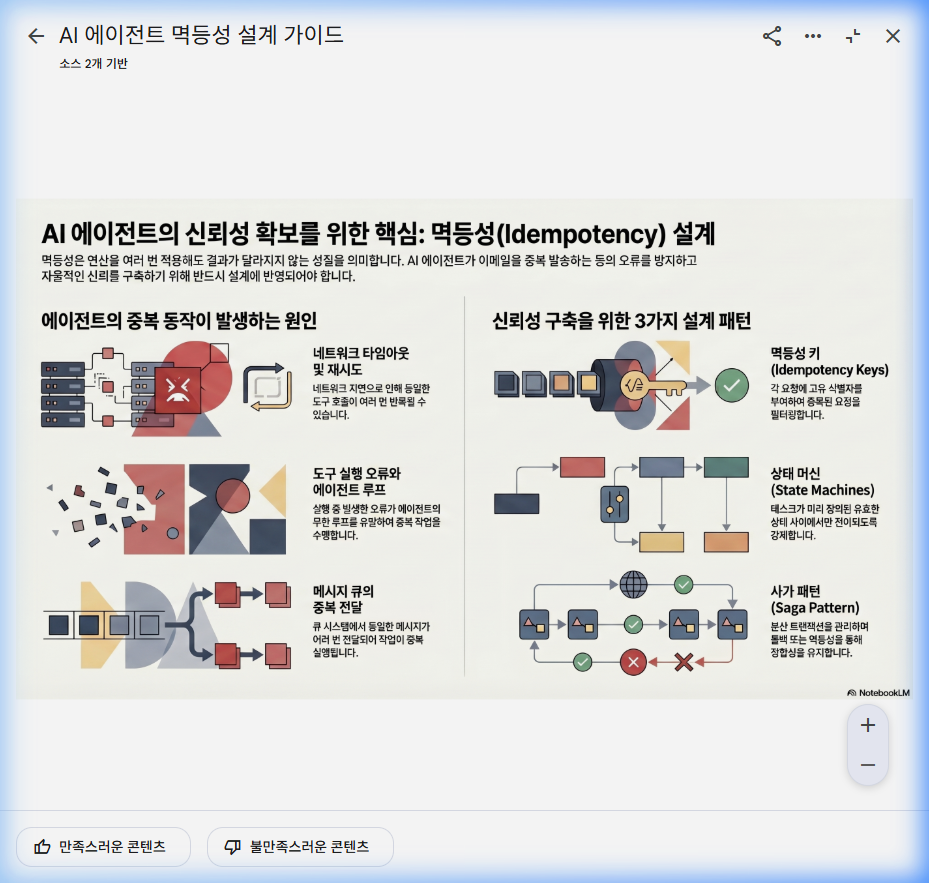
What is Idempotency?
In mathematics, idempotency means "a property where applying the same operation multiple times produces the same result as applying it once."
f(f(x)) = f(x) ← Same result no matter how many times you run it
In software, we express it this way:
Executing the same request multiple times should produce the same result as executing it once.
For example:
# NOT idempotent (dangerous)
def send_email(customer_id: str, content: str):
    email = get_email(customer_id)
    send(email, content)  # Every call sends one more email

# Idempotent (safe)
def send_email_idempotent(customer_id: str, content: str, idempotency_key: str):
    if already_sent(idempotency_key):
        return {"status": "already_sent"}  # Already sent — just return success

    email = get_email(customer_id)
    send(email, content)
    mark_as_sent(idempotency_key)
    return {"status": "sent"}
Why Is This Especially Dangerous for AI Agents?
With a regular API, a human explicitly clicks "Resend." AI agents are different.
AI agents automatically retry in these situations:
- When a network timeout occurs
- When the response to a tool call is ambiguous ("Not sure if it succeeded — let me try again")
- In multi-agent systems, when two agents perform the same task simultaneously
- When an agent is force-killed mid-task and then restarted
AI doesn't perfectly remember and track "what it just did." If a network response is slightly slow, it may confuse "did this succeed?" with "have I done this yet?"
Three Real-World Risk Scenarios
Scenario 1: Double Payment Processing
Agent: Receives a customer payment processing request
Agent: Calls payment_tool → No response (timeout)
Agent: "Not sure if that worked?" → Calls again
Payment system: Charges twice
Customer: Files a double-billing complaint
Scenario 2: Duplicate Contract Signing Request
Agent A: Sends email to legal team requesting contract signature
Agent B: (Backup agent assigned to same task) Sends the same email again
Legal team: Receives two requests for the same contract — confusion ensues
Scenario 3: Duplicate Database Records
Agent: INSERTs new customer data into DB
Agent: Response delayed → INSERTs again
DB: Two duplicate records created (hard to detect without a primary key)
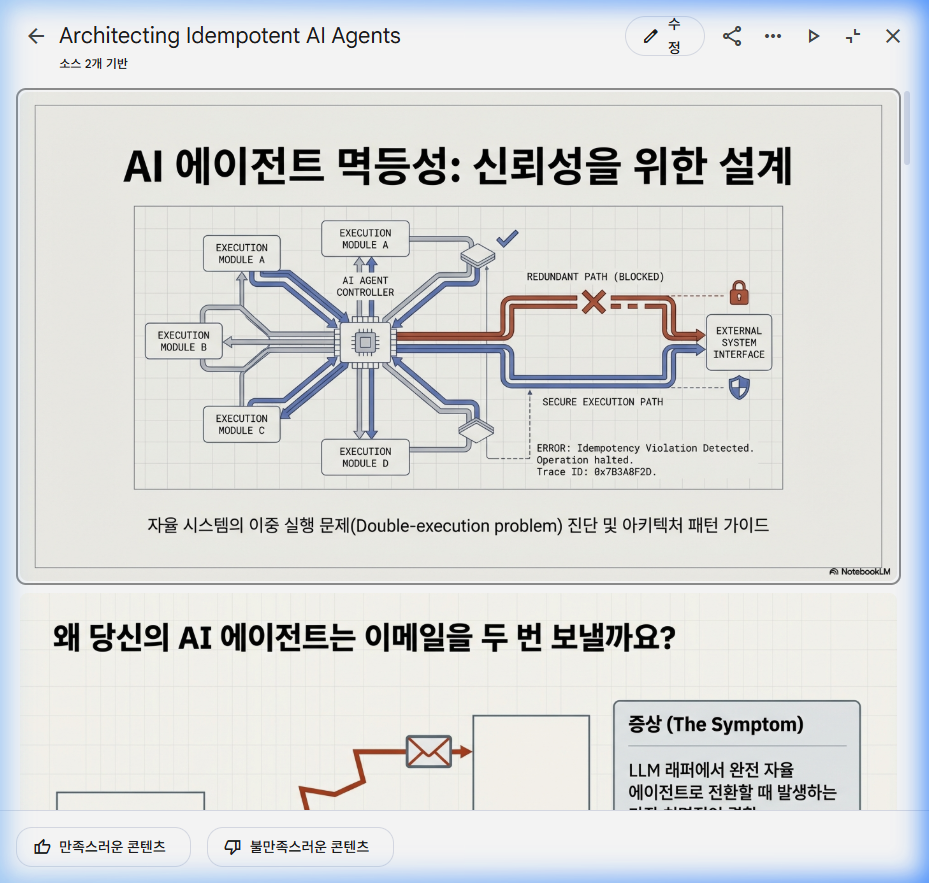
Production Idempotency Implementation Patterns
Pattern 1: Idempotency Key-Based Deduplication
The most versatile approach. Assign a unique key to each agent action and use it to block duplicate execution.
import hashlib
import json

class IdempotencyGuard:
    def __init__(self, store):
        self.store = store  # Redis, DB, etc.

    def generate_key(self, action: str, payload: dict) -> str:
        """Same action + same data = same key = natural idempotency"""
        content = f"{action}:{json.dumps(payload, sort_keys=True)}"
        return hashlib.sha256(content.encode()).hexdigest()[:16]

    def execute_once(self, key: str, action_fn, *args, **kwargs):
        """If key exists, return stored result. Otherwise, execute and store."""
        existing = self.store.get(key)
        if existing:
            return json.loads(existing)  # Return previously executed result

        result = action_fn(*args, **kwargs)
        self.store.set(key, json.dumps(result), ex=86400)  # Store for 24 hours
        return result

# Apply to agent tools
guard = IdempotencyGuard(redis_client)

def send_contract_email(customer_id: str, contract_id: str):
    key = guard.generate_key("send_contract_email", {
        "customer_id": customer_id,
        "contract_id": contract_id
    })

    return guard.execute_once(
        key,
        _actually_send_email,  # The real send function
        customer_id,
        contract_id
    )
Pattern 2: State Machine-Based Task Tracking
Best suited for complex multi-step operations. Explicitly persists the status of each task.
from enum import Enum

class TaskStatus(Enum):
    PENDING = "pending"
    IN_PROGRESS = "in_progress"
    COMPLETED = "completed"
    FAILED = "failed"

class AgentTask:
    def __init__(self, task_id: str, db):
        self.task_id = task_id
        self.db = db

    def execute(self, steps: list):
        task = self.db.get_task(self.task_id)

        if task["status"] == TaskStatus.COMPLETED:
            return task["result"]  # Already done — do NOT re-execute

        if task["status"] == TaskStatus.IN_PROGRESS:
            # Another agent is already running this
            raise ConflictError("This task is already being executed")

        self.db.update_status(self.task_id, TaskStatus.IN_PROGRESS)

        try:
            result = self._execute_steps(steps)
            self.db.update_status(self.task_id, TaskStatus.COMPLETED, result)
            return result
        except Exception as e:
            self.db.update_status(self.task_id, TaskStatus.FAILED, error=str(e))
            raise
Pattern 3: The Saga Pattern — Rollback on Failure
When an agent operates across multiple systems, a mid-task failure means already-completed steps need to be unwound.
class AgentSaga:
    """Step-by-step execution + reverse compensating transactions on failure"""

    def __init__(self):
        self.steps = []
        self.compensations = []

    def add_step(self, action, compensation):
        """action: the actual work; compensation: the rollback function"""
        self.steps.append(action)
        self.compensations.append(compensation)

    def execute(self):
        completed = []

        for i, (step, compensation) in enumerate(zip(self.steps, self.compensations)):
            try:
                result = step()
                completed.append((i, compensation, result))
            except Exception as e:
                print(f"Step {i} failed: {e}")
                print("Starting rollback...")

                # Roll back completed steps in reverse order
                for idx, comp, res in reversed(completed):
                    try:
                        comp(res)
                        print(f"Step {idx} rolled back successfully")
                    except Exception as rollback_error:
                        print(f"Rollback failed (manual intervention needed): {rollback_error}")
                raise

# Usage: contract processing agent
saga = AgentSaga()

saga.add_step(
    action=lambda: create_contract_record(customer_id, contract_data),
    compensation=lambda result: delete_contract_record(result["contract_id"])
)

saga.add_step(
    action=lambda: charge_payment(customer_id, amount),
    compensation=lambda result: refund_payment(result["charge_id"])
)

saga.add_step(
    action=lambda: send_confirmation_email(customer_id),
    compensation=lambda result: None  # Can't unsend — just log it
)

saga.execute()  # Auto-rollback on failure
Summary: Core Principles for AI Agent Developers
| Principle | Explanation |
|---|---|
| Check for duplicates first | Always ask "Have I already done this?" before executing |
| Assign Idempotency Keys | Issue a unique key for every external action |
| Externalize state | Store state in external DB, not inside the agent |
| Prepare compensation transactions | Design a rollback for every action |
| Retry ≠ Re-execute | Only allow retries when the same result is guaranteed |
Closing Thoughts
In the era of autonomous AI agents, developers must treat "the agent will make mistakes" as a baseline assumption — not an edge case.
Rather than trying to make your agent run perfectly with zero errors, designing your system so mistakes produce no side effects is far more realistic and far more robust.
Next time you add an external API tool to an AI agent, ask yourself:
"What happens if this tool gets called twice?"
If you don't have an immediate answer, your design isn't finished yet.

Henry — Robot Education Founder
Engineer dedicated to democratizing robot education for everyone. From hardware bring-up to AI integration, I document real learning.
Comments
Loading comments...